James R. Scott —
The Man Who Filed in the "New Rome"
James R. Scott was a Washington, D.C. resident — one of three D.C.-based signatories whose local addresses gave the 1904 incorporation its territorial claim to D.C. jurisdiction. The filing in the District of Columbia was not incidental. Washington, D.C. is a federal territory — designed after Rome, governed by a special federal charter, home to the Capitol dome that echoes the Roman Pantheon. Scott's D.C. address placed the "new organization" explicitly within the jurisdiction of the federal government's own seat of power.
Washington, D.C. — The "New Rome"
The District of Columbia was established in 1790–1791 as a special federal territory — not a state, not subject to the ordinary sovereignty claimed by the thirteen original states — but a jurisdiction belonging entirely to the federal government. Its founders deliberately modeled it after Rome.
Rome — The Original
- The Pantheon — dome dedicated to all gods
- The Forum — center of civic and religious law
- The Tiber Island — sacred judicial ground
- Obelisk brought from Egypt — sun worship symbol
- Senate — from Latin "senatus" (council of elders)
- Church-state unity under Roman law
Washington, D.C. — The Copy
- U.S. Capitol dome — deliberately Pantheon-shaped
- The National Mall — seat of civic and legal power
- Supreme Court — modeled on Roman legal tradition
- Washington Monument — Egyptian obelisk, sun symbol
- U.S. Senate — direct heir of Rome's "senatus"
- Church-state unity via civil incorporation — April 1904
James R. Scott's Washington, D.C. address was the geographic stamp that placed the 1904 corporation inside this Roman-modeled federal structure. The pioneers left old Rome behind in 1844. Scott and the other signers walked back into New Rome in 1904.
“When Church and State are united — when religious organizations use the power of civil government to enforce their religious observances — that is the very essence of the Papacy.”— Alonzo T. Jones, "The Two Republics," 1891. Jones had just argued before the U.S. Senate against the National Sunday Law. In 1904, his own denomination did what he spent his life opposing.
What James R. Scott Signed
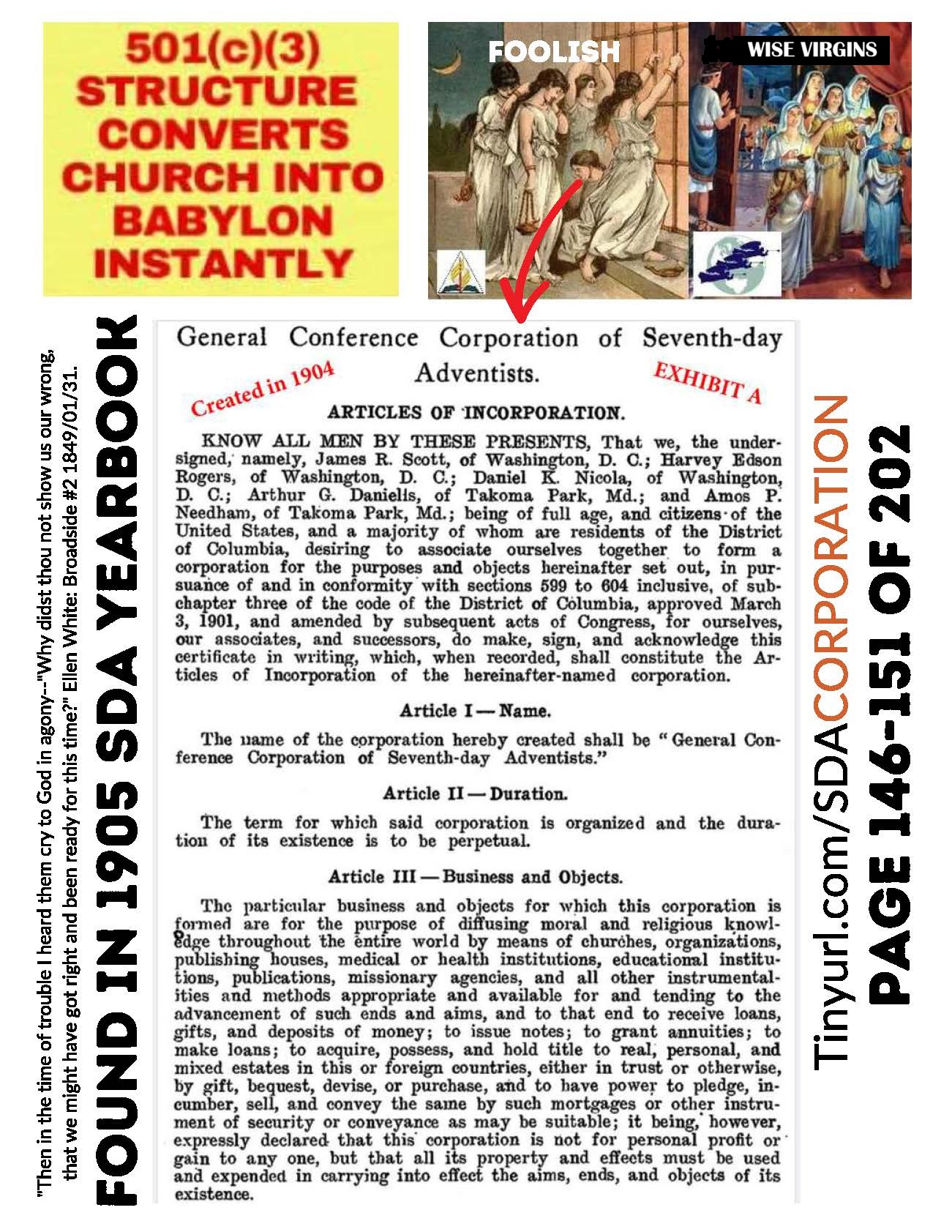
Scott signed the Articles of Incorporation for the “General Conference Corporation of Seventh-day Adventists” in the District of Columbia on April 15, 1904. His Washington, D.C. residency made him one of the legally required local signatories to establish D.C. jurisdiction for the new civil-religious corporation.
Under D.C. corporate law, articles of incorporation required signatories to establish legal domicile and citizenship within the jurisdiction. Scott's three D.C. co-signers (including Rogers and Nicola) collectively guaranteed that the corporation was validly formed within the federal capital's legal authority. The church was now a creature of Caesar's own city.
What Ellen White Told GC Leadership Before April 1904
“We cannot now enter into any new organization, for this would mean apostasy from the truth.”— Ellen G. White, 1SM 204 (Letter 242, October 1903)
“And I beheld another beast coming up out of the earth; and he had two horns like a lamb, and he spake as a dragon.”— Revelation 13:11 — The "lamb-like beast" whose seat of government is in Washington, D.C. — the "New Rome." By incorporating in D.C., the GC placed itself under the authority of this prophetic power the pioneers had spent decades exposing.
“The two-horned beast represents those religious bodies who, following in the steps of Rome, would cause the earth to look toward, and worship, the image of the Papacy.”
— James White, Review & Herald, 1877 — James White identified Washington, D.C. as the seat of prophetic power in Revelation 13. Scott filed the 1904 papers in this very city.The Charges Against James R. Scott
- IProviding D.C. jurisdiction for the 1904 apostasy. Scott's Washington, D.C. address was legally required to establish the corporation's federal capital jurisdictional basis. Without D.C.-based signatories, the filing could not have constituted a valid D.C. corporation. His participation was structurally essential.
- IIPlacing the church under the authority of prophetic Babylon. By filing in the city the pioneers themselves identified as the seat of prophetic power (Rev. 13, the lamb-like beast), Scott placed the Seventh-day Adventist identity under the authority of the very system the Three Angels' Messages call God's people to "come out of."
- IIIRejecting the prophetic warning against a "new organization." Ellen White's Letter 242 (October 1903) was written to all GC leadership, not to Daniells alone. Scott, as a D.C.-resident GC-aligned officer, had access to or knowledge of the prophetic warning and chose to sign in defiance of it.
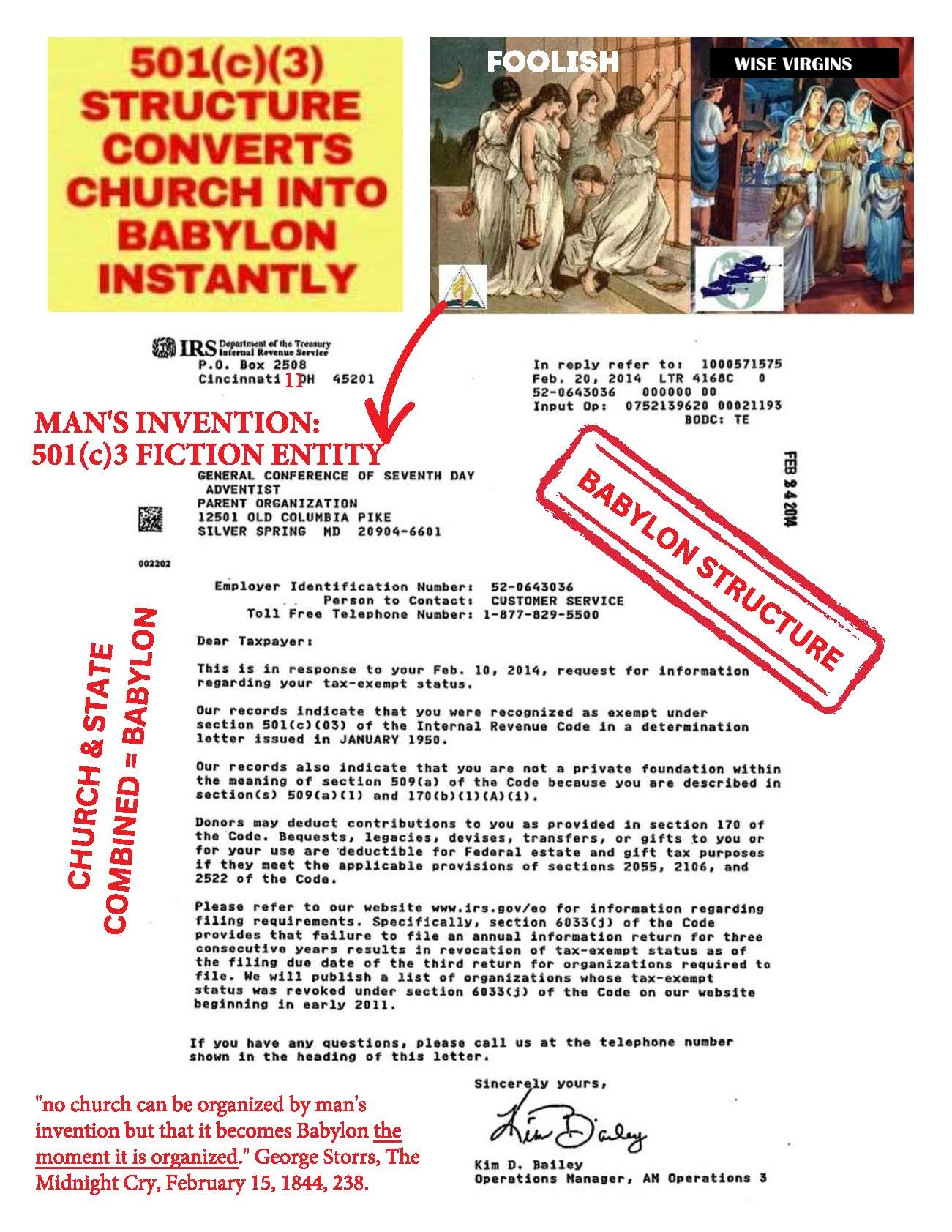
- IVIRS Subjugation. The D.C. corporation eventually became the parent denomination for 501(c)(3) tax-exempt status under the IRS — a U.S. Treasury entity. The church's freedom to preach became conditional on the government's tax-exemption rules. Scott's filing made this possible.
- VContributing to Idem Sonans name theft. By helping constitute the D.C. corporation bearing the name "Seventh-day Adventists," Scott was complicit in building the legal entity that would claim the pioneer movement's name, libraries, and legacy via Idem Sonans doctrinal identity.
“Congress shall make no law respecting an establishment of religion, or prohibiting the free exercise thereof…”— First Amendment, U.S. Constitution, ratified December 15, 1791
The First Amendment was designed specifically to prevent the Congress — whose chambers sat in the same city where Scott filed the 1904 papers — from controlling religion. Scott voluntarily brought the church into D.C. corporate jurisdiction, handing Congress (and eventually the IRS) the legal hook it needed to monitor, condition, and regulate the denomination's institutional behavior. Official source: constitution.congress.gov →