The Document They Signed
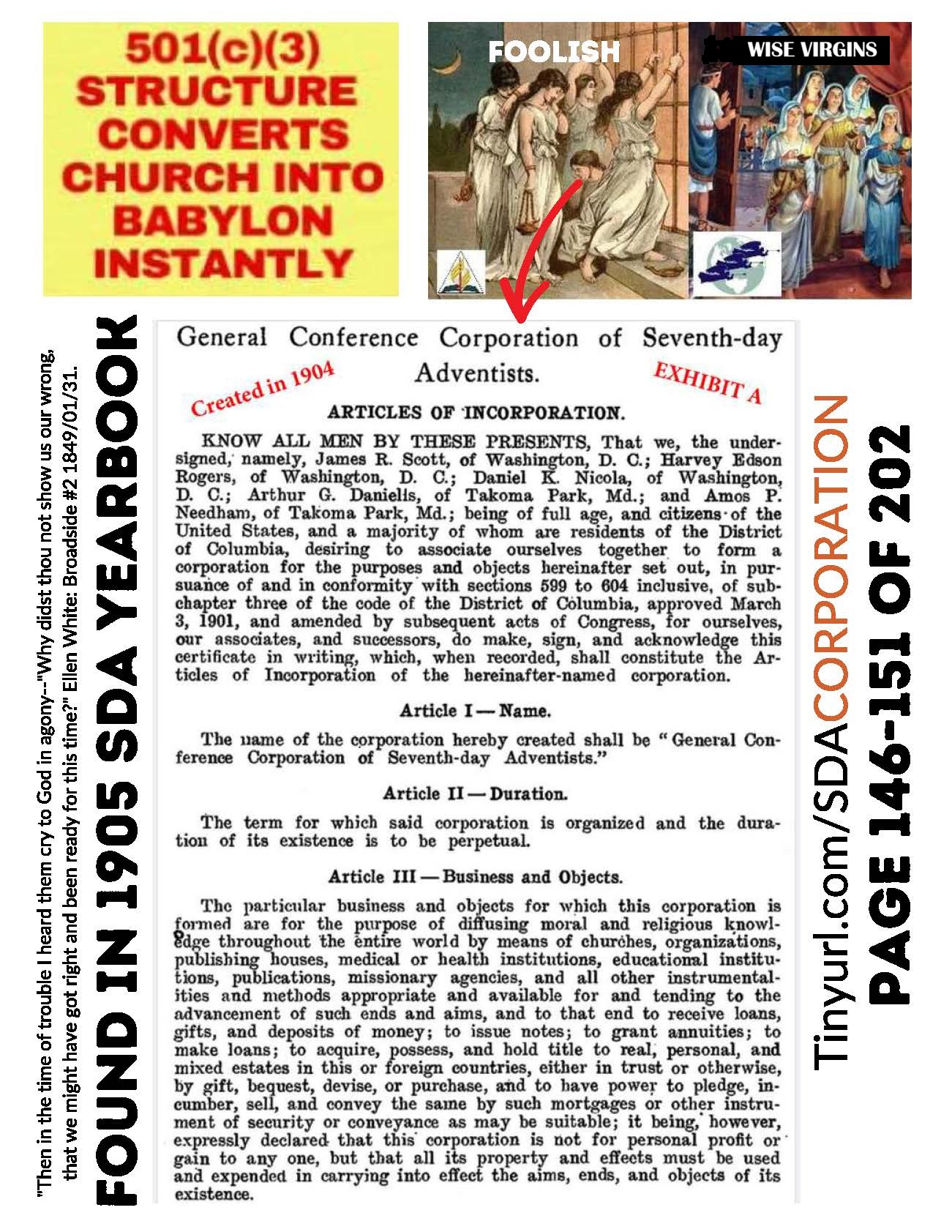
The Articles of Incorporation were filed on April 15, 1904, and later published in the 1905 Seventh-day Adventist Yearbook (pages 139–156). The document bears five signatures. Each man listed below signed his name to this act of apostasy.
What Ellen White Said Six Months Before
These five men did not act in ignorance. Ellen White had addressed the General Conference leadership directly in October 1903 — six months before April 15, 1904 — with an explicit warning about entering a new organization. Her words could not be misunderstood. They signed anyway.
“We have our Bibles. We have our experience, attesting to the truth of God’s word, and we cannot now enter into any new organization, for this would mean apostasy from the truth.”— Ellen G. White, 1SM 204 (Letter 242, October 1903)
The word “apostasy” is not a mild term. It means a complete rejection and betrayal of the faith — a turning from God’s established order to a human system. This is the word Ellen White chose. She did not say it would be “unwise” or “premature.” She said it would be apostasy.
In the same letter, she wrote: “The enemy of souls has sought to bring in the supposition that a great reformation was to take place among Seventh-day Adventists… The principles of truth that God in His wisdom has given to the remnant church, would be discarded. Their foundation would be built on the sand, and storm and tempest would sweep away the structure.”
Five Men. One April Morning. One Act of Apostasy.
The Articles of Incorporation list five signatories. Two groups: three from Washington, D.C. proper, and two from Takoma Park, Maryland (at the time still partly in Maryland jurisdiction). Each man held a position of authority and trust within the Adventist movement. Each betrayed that trust on April 15, 1904.
Loughborough’s Five Steps of Apostasy
John Norton Loughborough was one of the founding pioneers of Seventh-day Adventism. He helped James White build the original movement from the ground up, beginning in 1848. In October 1861 — forty-three years before Daniells signed the incorporation — Loughborough wrote the following in the Review and Herald. It is a precise description of what the five 1904 signers did.
- 1Get up a creed, telling us what we shall believe. The 1904 incorporation imposed a legal structure defining who the Adventist Church is and what it may do — a civil creed, enforceable by courts.
- 2Make that creed a test of fellowship. Membership in the corporate body became the test — those outside the corporation are excluded from the name, the buildings, and the platform.
- 3Try members by that creed. Disfellowship proceedings in the corporate denominational church follow the corporate bylaws, not the naked Bible standard of the pioneers.
- 4Denounce as heretics those who do not believe that creed. Non-corporate Adventists who preach the original pioneer platform are labeled “independent,” “off-shoot,” or “fanatical” by the corporate body.
- 5Commence persecution against such. The corporate body uses trademark law and civil courts to prevent non-corporate Adventists from using the name “Seventh-day Adventist” — the name the pioneers chose in 1860 and never registered with any government.
“The first step of apostasy is to get up a creed, telling us what we shall believe… the second is to make that creed a test of fellowship; the third is to try members by that creed; the fourth to denounce as heretics those who do not believe that creed; and fifth, to commence persecution against such.”
— John N. Loughborough, Review & Herald, October 8, 1861How They Stole the Pioneer Name
The name “Seventh-day Adventist” was chosen in 1860 by a free assembly of the founding pioneers. It was never registered with any government. It was a prophetic name — belonging to all who kept the Commandments of God and had the Faith of Jesus (Revelation 14:12). It was not owned. It was inhabited.
Under the legal doctrine of Idem Sonans (“sounding the same”), two names that sound nearly identical are treated as referring to the same entity in legal proceedings. The 1904 corporate name was deliberately engineered to echo the pioneer name. Any layperson hearing both would assume they referred to the same body of believers.
This is how the five signers stole the identity, legacy, and moral authority of the pioneer movement. They used the ancient name to capture its credibility — then used civil courts to prevent the actual spiritual heirs of that name from legally claiming it. The corporate body has since trademarked “Seventh-day Adventist” and litigated against independent Adventist congregations who use their own pioneers’ name.
Wikipedia: Idem Sonans → • US Legal Forms →The First Amendment They Surrendered
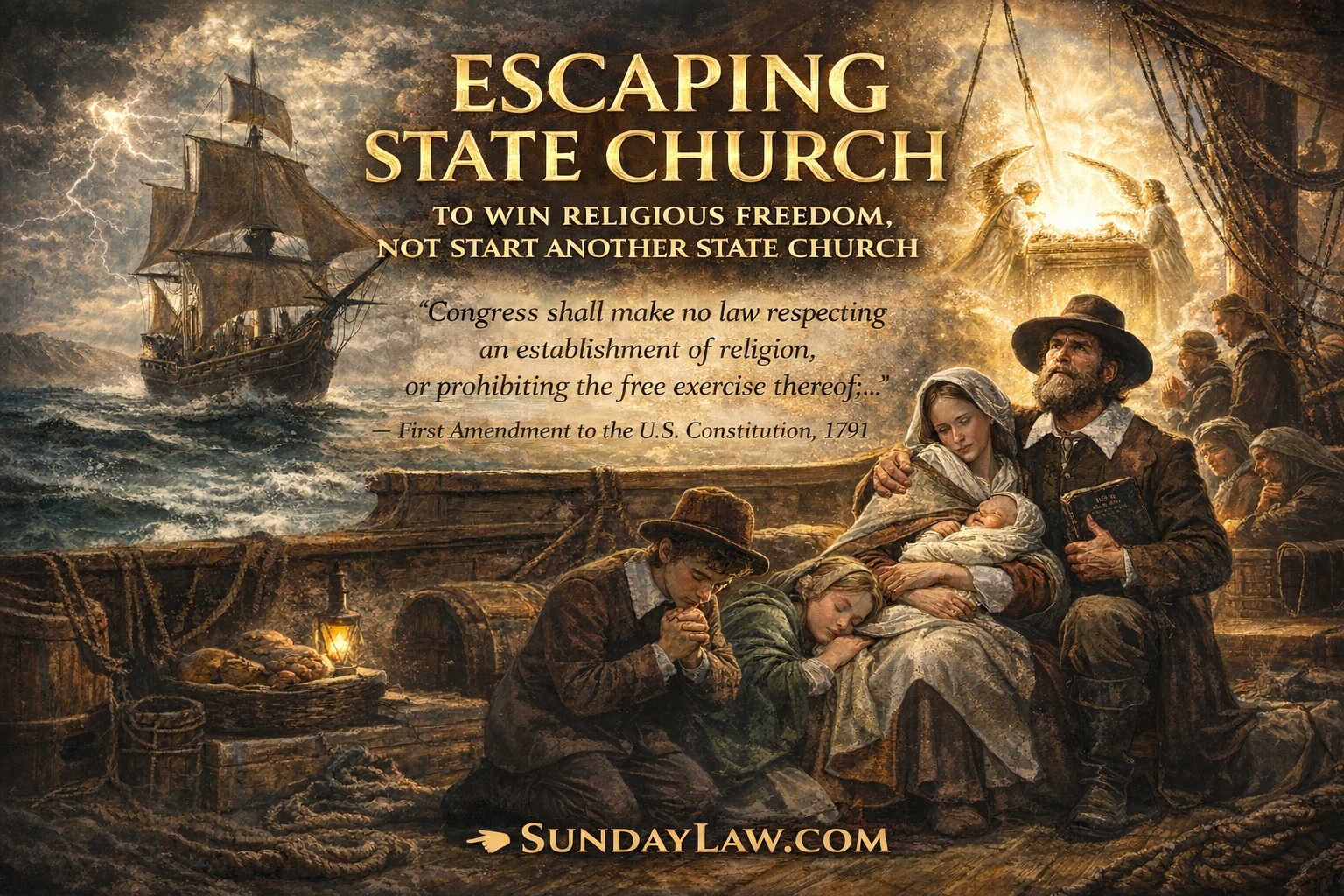
“Congress shall make no law respecting an establishment of religion, or prohibiting the free exercise thereof…”— First Amendment, Bill of Rights, U.S. Constitution, December 15, 1791
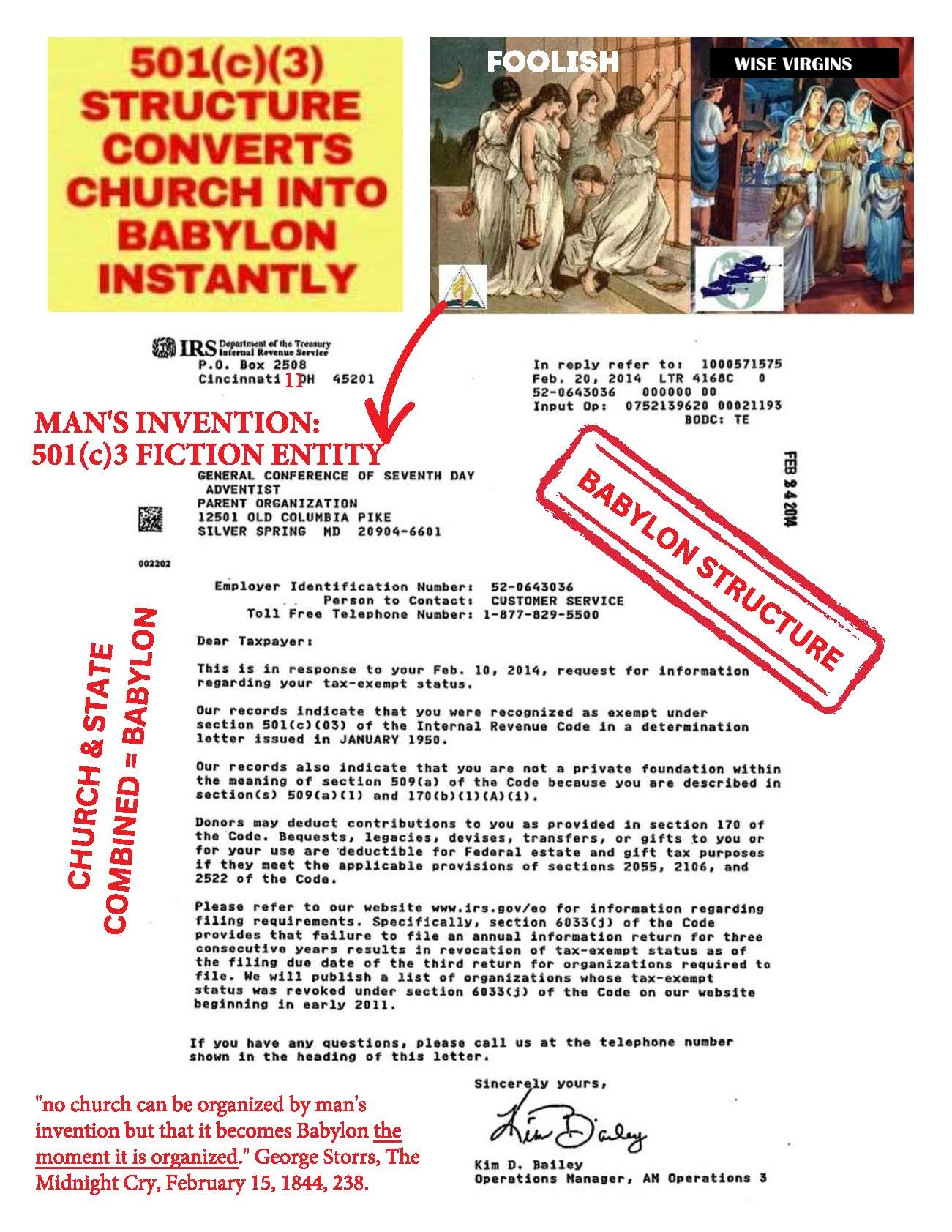
The First Amendment was designed by men who had fled state-church tyranny. It guaranteed that no church would be placed under government legal authority. By voluntarily incorporating under the laws of the District of Columbia — a federal jurisdiction under the “UNITED STATES” corporate entity — the five signers placed the Adventist church under government oversight. The First Amendment protected them from government control of their religion. They voluntarily surrendered that protection on April 15, 1904.
Official Source: constitution.congress.gov →From the Mayflower to the Most Holy Place
The story did not begin with William Miller. It began two centuries before, on a wooden ship fleeing the state churches of Europe. The Pilgrims did not merely cross an ocean — they carried with them the conviction that no government, no king, and no corporate ecclesiastical body could stand between a soul and its God. That conviction became the soil in which the Advent movement was planted. In 1904, five men buried it.
“Having undertaken, for the Glory of God and advancement of the Christian Faith…”
The Pilgrims fled the Church of England — a state church backed by civil law and civil courts. They did not seek to build a new state church. They sought only the freedom to follow God’s Word without a corporate institution standing between them and their conscience. James White’s own family roots trace to these same New England dissenter communities.
“The temple of God was opened in heaven, and there was seen in His temple the ark of His testament.” — Revelation 11:19
On October 22, 1844, the veil before the Most Holy Place was drawn aside. The remnant — the direct spiritual heirs of every soul who ever fled state-church tyranny for conscience’ sake — entered by faith into a ministry no earthly organization could contain, register, or trademark. The arc from Plymouth Rock to the Advent movement was complete.
The very thing the Pilgrims crossed an ocean to escape —
a civil church with legal authority —
was created in Washington, D.C. on April 15, 1904.
By incorporating under the laws of Caesar’s own capital, the five signers erected the precise structure their spiritual forebears had died to escape. Not a church fleeing the state. A church asking the state to define and protect it. The 284-year arc of religious liberty was broken on a single April morning.
“To the end of time, the presence of the Spirit is to abide with the true church.”
— Ellen G. White, The Acts of the Apostles, p. 55No civil incorporation can constitute the true church. No Articles of Incorporation can create it. No five signatures can end it. The true church — from the Mayflower to the Most Holy Place — exists wherever two or three gather in the name of Christ, holding the Commandments of God and the Faith of Jesus. It cannot be trademarked. It cannot be incorporated away.
From the Advent Movement to April 15, 1904
The Documentary Record
Each of the resource links below is part of the public historical record. This is not interpretation — it is documentation.