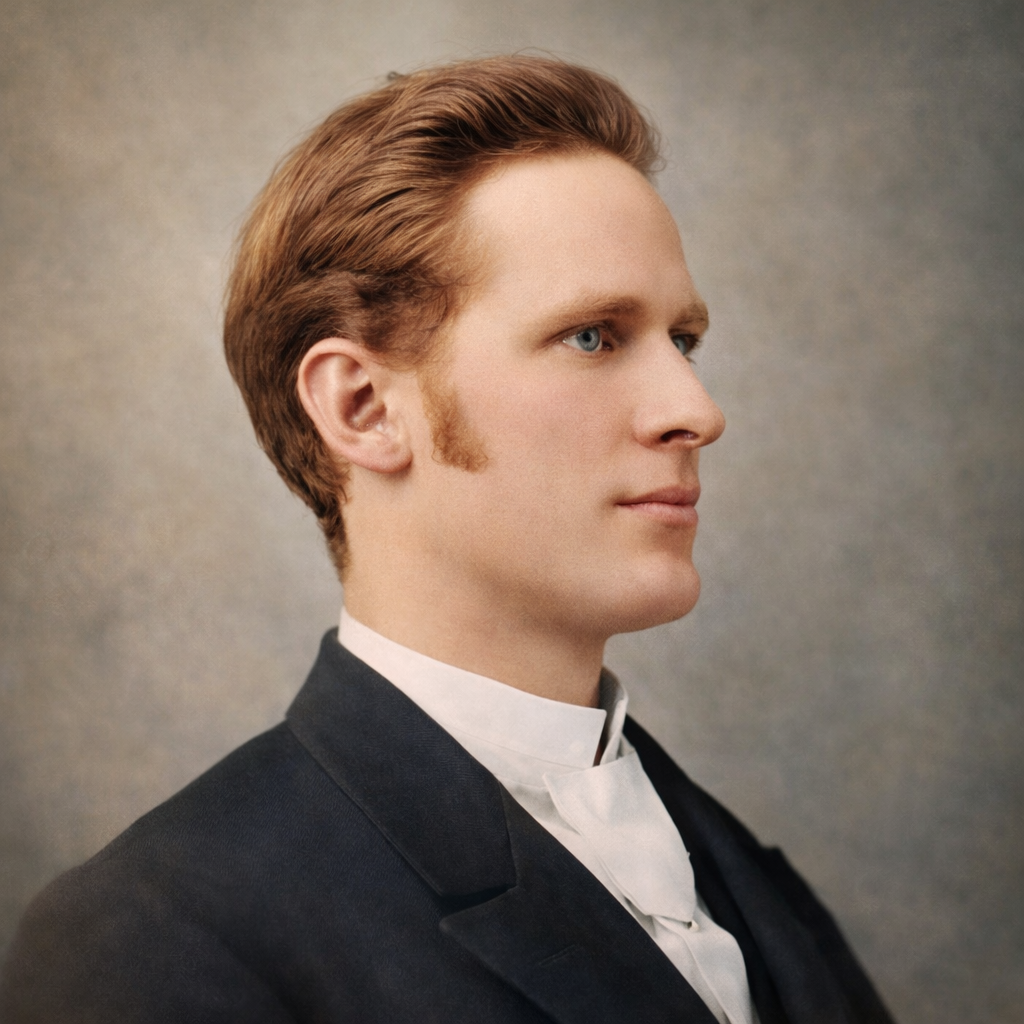
Biography
Herbert Camden Lacey (1871–1950), often known as Camden, was born in Leicester, England, on November 15, 1871, to David and Annie Rebecca (Angrave) Lacey. His family moved frequently, living in India and various parts of England before emigrating to Hobart, Tasmania, Australia, in 1882. Raised Episcopalian, Camden attended St. David’s Cathedral School in Hobart, receiving a strong classical education.
The Lacey family became Seventh-day Adventists in 1888 after attending evangelistic meetings by Mendel Israel. Camden, then 18, sailed to California in 1889 to attend Healdsburg College, where he tutored Greek and Latin and graduated from the ministerial course in 1892. He continued his studies at Battle Creek College, completing the classical course in 1895. That year, he married Lillian Yarnell and returned to Australia for a teaching appointment at the soon-to-open Avondale School for Christian Workers.
Lacey taught a variety of subjects at Avondale and was ordained in 1896. He later served as secretary of the New South Wales Conference and taught at Avondale when it opened in 1897. He was known for his rapport with students and his classical scholarship. After a brief period of tension with other faculty and Ellen White’s guidance, he left Australia in 1898.
Lacey’s career included teaching and administrative roles in New Zealand, the United States, and England. He was vice-president of Healdsburg College, principal of Stanborough Park Missionary College in England, and a Bible teacher at Union College and Washington Missionary College in the U.S. He also conducted ministerial training in China, the Philippines, Manchuria, Japan, and the East Indies.
Later, Lacey served as a pastor in California and New York, and as a lecturer at the College of Medical Evangelists. He published numerous articles, especially on the imputed righteousness of Christ, and was a frequent contributor to The Ministry magazine. He retired in 1948 after more than 50 years of service and died in Glendale, California, on December 8, 1950. He is buried at Forest Lawn Memorial Park, Glendale.
Lacey’s influence on Adventist theology, especially regarding the Holy Spirit and the Trinity, is well documented through his teaching, correspondence, and published works. His legacy is both celebrated and debated within Adventist history.
"One thing I do recall is my mother's remarking on the strange language used by our ministers in speaking of the Holy Ghost as 'it' and 'its' as though they thought of the Holy Spirit as an influence, instead of as a Person. That seemed very strange to her, and in a measure to me also."
"When the Desire of Ages came out in 1898, Brother Daniells himself called my attention to the expression found on page 671, where the Spirit is spoken of as 'the third person of the Godhead.' Later, in Testimonies for the Church, Series B, No 7 on page 63 (Nov 1905) I found this paragraph—'There are three living persons in the heavenly trio...'—exactly as I had endeavoured to teach 9 years previously."
"At that time, Professor Prescott was tremendously interested in presenting Christ as the great 'I Am' and in emphasizing the eternity of His existence, using frequently the expression 'The Eternal Son.' ... Sr. Marian Davis seem to fall for it, and lo and behold, when 'Desire of Ages' came out, there appeared that identical teaching on pages 24 and 25, which, I think, can be looked for in vain in any of Sr. White's published works prior to that time."
— Letters of H.C. Lacey to Leroy Froom, 1945