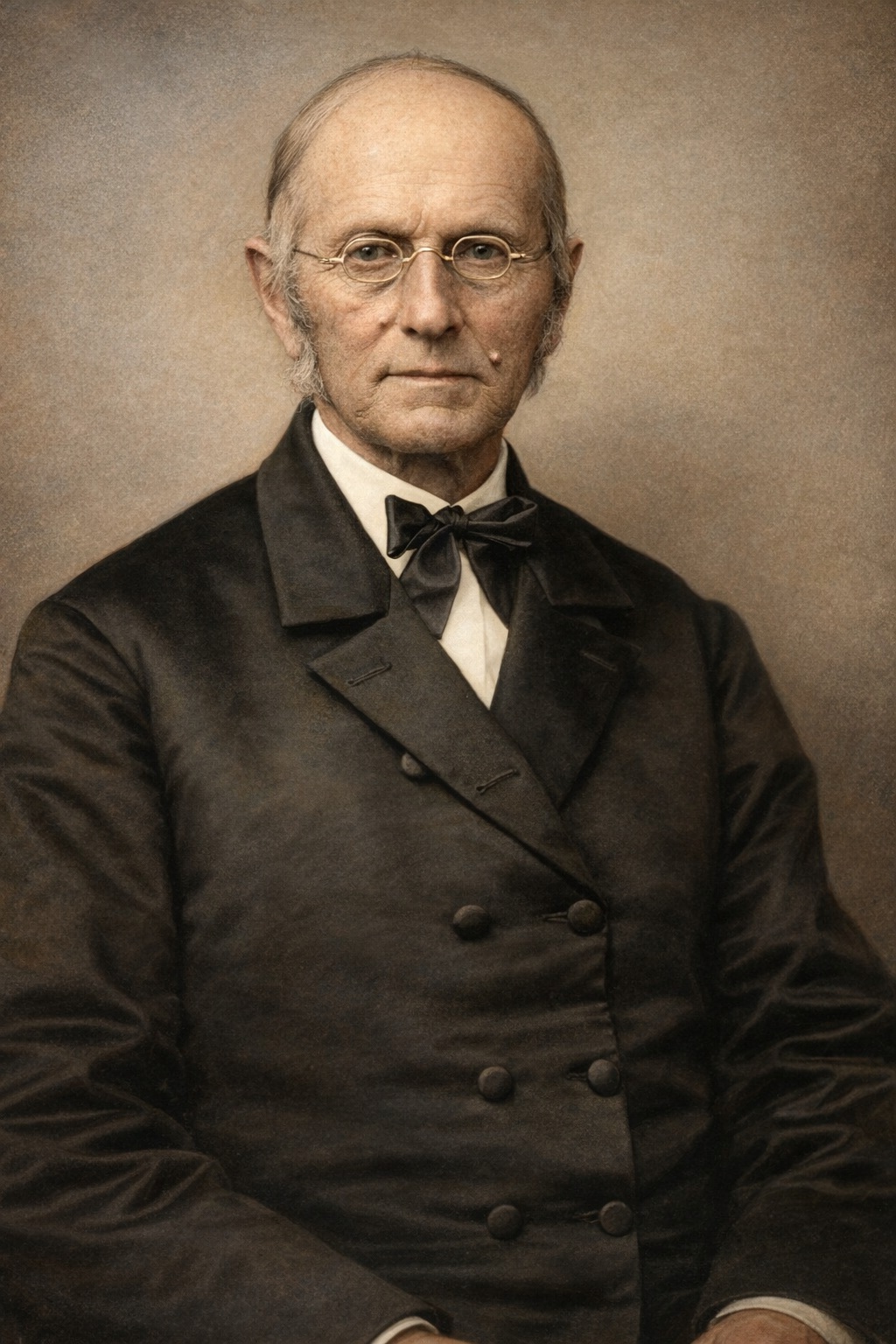
Early Life at Sea
Joseph Bates was born in Rochester, Massachusetts, on July 8, 1792, and grew up near Fairhaven. He went to sea as a teenager—reportedly at age 15—and spent two decades as a merchant sailor, eventually earning his master's papers and commanding his own vessels.
During the War of 1812 he was impressed into British naval service and held captive for nearly a year before being released. He sailed under difficult conditions, witnessed hardship at sea, and developed the discipline and directness that would define his ministry. By 1827 he had accumulated enough wealth to retire comfortably from the sea.
Conversion and Total Reform
According to his own autobiography, Bates's wife, Prudence Nye Bates, packed a Bible for him on a voyage. His reading during that journey contributed to his eventual conversion to the Christian faith. After his retirement from the sea, he threw himself into reform movements: temperance, abolition of slavery, anti-tobacco, anti-tea and coffee, and dietary reform.
He gave away nearly his entire savings in charitable and mission causes, including to tract societies and the emerging Advent movement. By the time he became deeply involved in Adventism, he had little materially left — and considered that entirely proper.
Millerite Movement and the Great Disappointment (1839–1844)
Bates accepted the Millerite message around 1839 after hearing William Miller preach on Daniel 8:14. He threw himself into Advent evangelism. He was a speaker, organizer, and writer in the movement that announced Christ's coming before October 22, 1844.
When the Great Disappointment came on October 22, 1844, Bates was among those deeply shaken but not completely cast down. He was convinced the day was correct even if the event was misunderstood — and he began searching the Scriptures with renewed intensity.
Sabbath Conviction (1845)
In 1845, Bates encountered a tract by Thomas M. Preble arguing for the seventh-day Sabbath from Scripture. He studied it carefully, and it convinced him. He immediately began preaching the Sabbath with full force.
His 1846 tract, The Seventh-Day Sabbath, a Perpetual Sign, was the first major Adventist work defending the seventh-day Sabbath. He argued from Exodus 31:13 and Ezekiel 20:12 that the Sabbath was a sign between God and His people — perpetual, not abolished, not transferred to Sunday.
The widow Rachel Oakes Preston and Elder Frederick Wheeler had already adopted the Sabbath in Washington, New Hampshire, by 1844 — but Bates did more than any other man to systematize and spread Sabbath theology in the early movement.
Convincing the Whites (1848)
At the Sabbath Conferences of 1848, held in Volney, Rocky Hill, Topsham, and Dorchester, Bates labored alongside James and Ellen White to establish the pillars of Adventist doctrine — Sabbath, sanctuary, state of the dead, and the Three Angels' Messages.
Ellen White recorded that before she received a vision confirming the Sabbath, Bates was not fully satisfied she had genuine prophetic gift. After the vision, in which she accurately affirmed the connections Bates had been teaching about the planets and astronomy, he became fully persuaded and said: "I am satisfied that her vision is of God."
The Sealing — A Seal of the Living God (1849)
Joseph Bates's 1849 tract, A Seal of the Living God (1849), is one of the most important documents of early Adventism. In it, Bates argued that:
- The seventh-day Sabbath is the seal of the living God referenced in Revelation 7
- The 144,000 of Revelation 7 and 14 are sealed with this mark — meaning they keep the commandments of God
- The sealing work began in connection with the heavenly sanctuary ministry on October 22, 1844
- The number of the 144,000 was being made up during the investigative judgment period
Bates connected the Sabbath, the sanctuary, and the sealing into a coherent prophetic framework that became central to Sabbatarian Adventism. His insight was not that the Sabbath was merely a day of rest — it was the identifying sign of those who are "married to the Lamb" as His bride, chosen through the investigative judgment.
Elder John Norton Loughborough, one of early Adventism's most durable pioneers, carried the sealing message forward into the twentieth century with his own 1916 study, exploring the same Revelation 7 sealing truth Bates had first laid out nearly seventy years earlier.
Read the sealing tract: A Seal of the Living God (PDF) Three Angels / Seal Summary: Full Summary (PDF)
Sabbath Conferences and Church Organization
Bates worked throughout the late 1840s and early 1850s organizing the scattered Adventist believers. He traveled widely, held meetings in private homes and small chapels, and helped link groups that had come to accept the Sabbath and sanctuary truths independently.
He strongly supported formal church organization when it finally came in 1861–1863, recognizing that the scattered state of the believers weakened the work. He was present at the formation of the Michigan Conference and the General Conference in 1863.
Waymarks and High Heaps (1847)
Another crucial Bates work is The Second Advent Waymarks and High Heaps (1847). In this tract he traced the prophetic waymarks from 1840 (First Angel's Message) through the Midnight Cry and October 22, 1844, showing that these were not mistakes but divine milestones. The publication was made possible because a widow sold her small farm and gave half the proceeds to print it.
The waymarks Bates identified remain foundational to historic Adventist understanding:
- The First Angel's Message — 1840–1844 (Revelation 14:6–7)
- The Tarrying Time — Matthew 25:5
- The Midnight Cry — Matthew 25:6
- The Seventh-Month Message — October 22, 1844
- The Great Disappointment and its meaning
- The Opening of the Most Holy Place in the Heavenly Sanctuary
- The Third Angel's Message — Revelation 14:9–12
Character and Reform
Bates was known for personal severity in reform. He abstained from alcohol, tobacco, tea, coffee, and meat. He pressed these reforms on others with what some described as excessive strictness. Historical records show he occasionally received correction from his fellow laborers regarding his tone, but he never abandoned the substance of what he taught.
He was also known for personal sacrifice. He gave his financial reserves to the cause, traveled at personal cost, and maintained a simple life to the end.
Death and Legacy
Joseph Bates died in Battle Creek, Michigan, on March 19, 1872. He was 79. His funeral was attended by many of the leading figures of early Adventism.
He is remembered as:
- Co-founder of Sabbatarian Adventism alongside James and Ellen White
- Principal theologian of the seventh-day Sabbath in the Advent movement
- Author of the foundational sealing tract connecting the Sabbath to the 144,000
- Early health reform advocate
- One of the central voices of the Sabbath Conferences (1848–1850) that built the pillars of Adventism
His connection between Sabbath, sanctuary, and sealing — articulated in A Seal of the Living God (1849) — remains the prophetic framework through which the 144,000 are understood to be sealed before the close of probation and the standing up of Michael (Daniel 12:1).
Sources
- Wikipedia: https://en.wikipedia.org/wiki/Joseph_Bates_(Adventist)
- Autobiography: Autobiography of Elder Joseph Bates (1868)
- Primary document: A Seal of the Living God (1849)